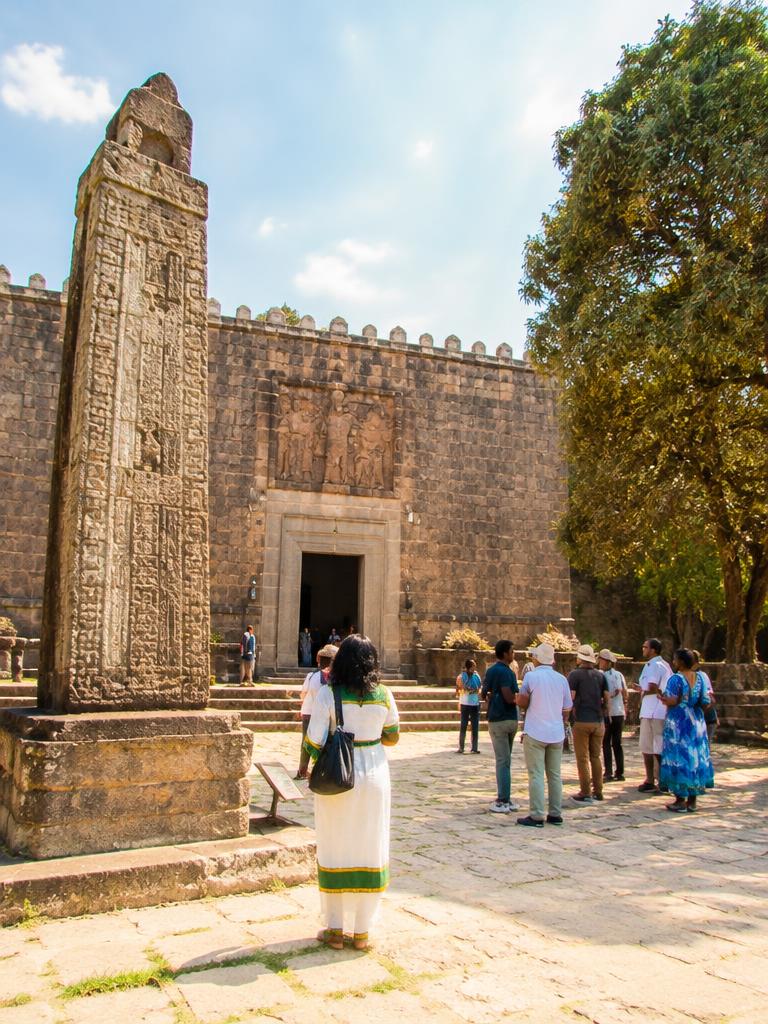
The National Museum of Ethiopia in Addis Ababa is a premier cultural repository famous for housing prehistoric hominid fossil displays such as Lucy and Selam. It features extensive historical, archaeological, artistic, and ethnographic exhibits detailing Ethiopia's rich past from antiquity to the modern era.
The National Museum of Ethiopia, located in Addis Ababa near the Addis Ababa University graduate school, is considered one of the most important museums in sub-Saharan Africa. The concept of the museum was introduced in 1936 with an exhibition of ceremonial costumes donated by the Solomonic dynasty, later developing further through the establishment of the Institute of Archaeology in 1958. It houses over 170,000 items spanning archaeological finds, religious manuscripts, royal paraphernalia, and artworks.
The museum's most famous attraction is its basement palaeontological and archaeological gallery, which features early hominid fossils including cast displays of Lucy (Australopithecus afarensis), dated to roughly 3.2 million years ago, alongside the fossil remains of Selam and extinct fauna such as the saber-toothed feline Homotherium and the pig Notochoerus. While the original bones are safeguarded in museum archives, the basement exhibition remains a primary draw for visitors.
The remaining floors showcase artifacts, art, and cultural items covering ancient, medieval, and modern Ethiopian history. Exhibits include pre-Aksumite, Aksumite, and Gonderian relics such as ancient Sabaean inscriptions, bronze oil lamps, and Emperor Haile Selassie's wooden throne. The upper levels present chronological displays of Ethiopian art, including Afewerk Tekle's "African Heritage," as well as secular arts, crafts, weapons, clothing, musical instruments, and ethnographic collections.
Facilities & services
- Guided tours
- Museum explainers / guides
- Gift shop selling postcards and books
Highlights
- Fossil casts of the 3.2-million-year-old hominid Lucy (Dinknesh) and fossil exhibits of Selam
- Extinct prehistoric animal fossils, including the saber-toothed cat Homotherium and savannah pig Notochoerus
- Pre-Aksumite and Aksumite historical artifacts, including an elaborate bronze oil lamp and ancient Sabaean inscriptions
- Lavish royal regalia, including Emperor Haile Selassie's carved wooden throne
- Chronological Ethiopian art collections, featuring Afewerk Tekle's painting African Heritage
- Traditional weapons, jewelry, musical instruments, and ethnographic displays
Details
- collections
- Over 170,000 items including secular and religious manuscripts, icons, ceremonial items, paintings, gold and silver embroidered robes, umbrellas, crosses, books, archaeological finds, and early hominid fossils including 'Lucy' (Dinknesh).
- exhibitions
- Divided across levels featuring paleontological discoveries (including Lucy/Dinknesh), ancient and medieval historical artifacts, Ethiopian artwork and secular arts and crafts, and ethnographic displays.
- guided tours
- Explainers are available at all times to guide and explain about the collections.
- Time needed
- 90 minutes to 3 hours (suggested duration: 2 hours).
- Accessibility
- The building has many staircases and is not wheelchair-accessible.
Visitor tips
- Wear comfortable walking shoes, as the museum spans several levels with many staircases and uneven flooring in the basement.
- Plan to spend between 90 minutes and 3 hours to comfortably explore all four exhibition floors.
- Look out for the museum shop area selling postcards and books.
- Note that dim lighting is maintained in the basement paleoanthropology section to protect the displays, so watch your footing.
Questions
Can visitors see the famous fossil Lucy?
Yes, the basement gallery displays the 3.2-million-year-old fossil cast of 'Lucy' (known locally as Dinknesh), alongside other hominid finds like the 3.3-million-year-old Selam (Dikika Child). The actual original bones of Lucy are kept securely in a vault.
How is the museum laid out?
The museum contains four primary levels: the basement is dedicated to paleoanthropology and prehistoric fossils; the ground/first level displays ancient and medieval artifacts and royal regalia; the next level presents Ethiopian art and traditional crafts; and another floor features ethnographic exhibits representing Ethiopia's diverse cultures.
Is the National Museum wheelchair accessible?
No, according to accessibility reports, the building features many staircases and is not wheelchair-accessible.
Are guided tours available?
Yes, museum explainers are available to guide and explain the collections, and outside guides are also sometimes available.
Sources
- lonelyplanet.com/points-of-interest/national-museum/455957
- et.africabz.com/addis-ababa/national-museum-of-ethiopia-2060
- en.wikipedia.org/wiki/National_Museum_of_Ethiopia
- ethiomuseums.com/National%20Museum.html
- momaa.org/directory/national-museum-of-ethiopia/
- bwpremieraddis.com/the-national-museum-of-ethiopia/