Holy Trinity Cathedral is the highest-ranking Ethiopian Orthodox cathedral in Addis Ababa and the second-most important place of worship in Ethiopia. Completed in 1942, it is famous as the resting place of Emperor Haile Selassie, empress Menen Asfaw, and numerous Ethiopian historical figures.
Holy Trinity Cathedral, known in Amharic as Kidist Selassie and bearing the title Menbere Tsebaot ('Pure Altar'), is an active Ethiopian Orthodox Tewahedo cathedral located in the Arat Kilo district of Addis Ababa. Initially established in December 1931 under Emperor Haile Selassie, construction was halted following the Italian invasion and ultimately completed in 1942 to commemorate Ethiopian victory over Italian occupation. Serving as the highest-ranking cathedral in Addis Ababa and the official seat of the Orthodox Archdiocese, it stands as one of the country's most significant places of worship alongside Axum's Church of Our Lady Mary of Zion.
The cathedral features a square basilica design with an architectural exterior highlighted by a large copper dome, spindly pinnacles, statues, and a blend of international styles. Inside, the layout follows a threefold division modelled on Solomon's Temple, encompassing an outer ring for congregational hymns, a middle circle for holy communion, and a priest-only inner circle housing the Tabot. Notable artistic and interior features include Afewerk Tekle’s grand murals depicting the Holy Trinity, stained-glass windows displaying Old and New Testament scenes, and two carved imperial thrones crafted from white ebony, ivory, and marble.
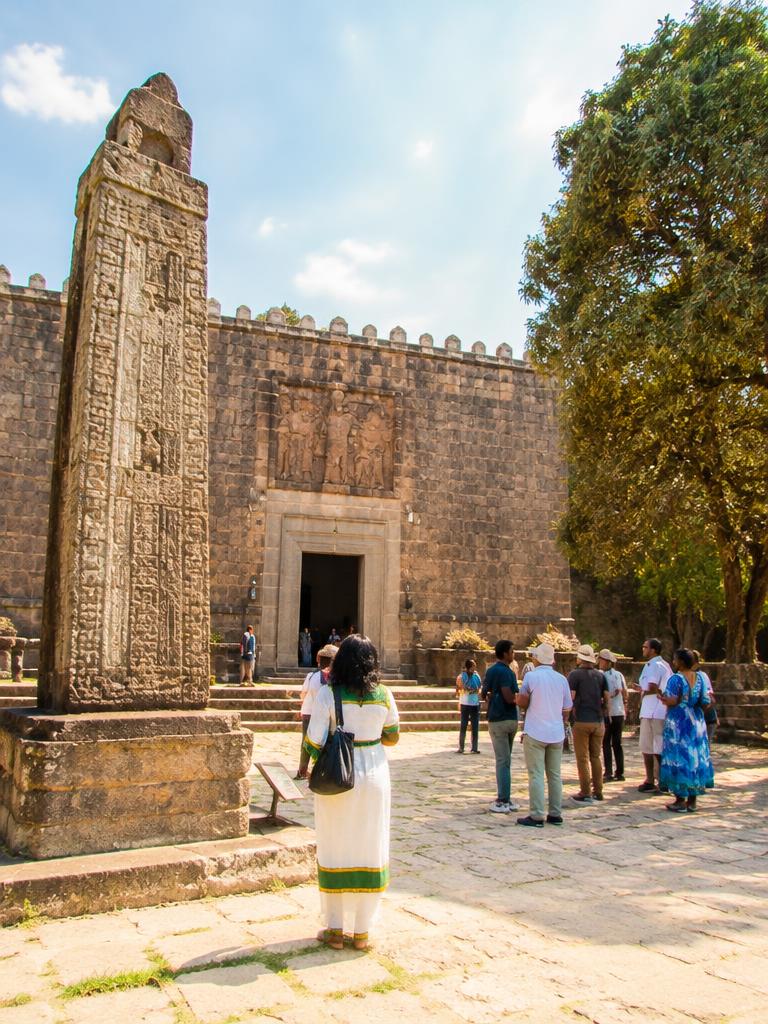
The complex functions as a prominent burial ground containing the massive Aksumite-style granite tombs of Emperor Haile Selassie and Empress Menen Asfaw. The surrounding grounds and churchyard feature memorials and graves of imperial ministers executed by the Derg regime, patriots who resisted the Italian occupation including Ras Imru, former Prime Minister Meles Zenawi, and British suffragette Sylvia Pankhurst. The broader complex also accommodates an ecclesiastical museum, the historic 'Bale Wold' Church, a monastery, primary and secondary schools, and the Holy Trinity Theological College.
Facilities & services
- Accessible parking
- Accessible restroom
- Museum
- Wheelchair accessible
Highlights
- Aksumite-style granite tombs of Emperor Haile Selassie and Empress Menen Asfaw
- Grand interior murals by Afewerk Tekle and biblical stained-glass windows
- Two carved imperial thrones composed of white ebony, ivory, and marble
- Grounds containing tombs of Sylvia Pankhurst, Meles Zenawi, and Ethiopian resistance patriots
- Ecclesiastical museum housing crowns, regalia, and historic artifacts
Details
- etiquette
- Remove shoes before entering inside; dress modestly with shoulders and knees covered.
- dress code
- Dress modestly with shoulders and knees covered, and remove shoes inside the cathedral.
- significance
- Second-most important place of worship in Ethiopia, highest-ranking cathedral in Addis Ababa, and the burial site of Emperor Haile Selassie, Empress Menen Asfaw, and prominent patriots.
- historical period
- Modern era / mid-20th century (established 1931, completed 1942)
- guide availability
- Available; self-appointed guides charge Birr 20 to Birr 30 per person, and museum explainers/staff are also available.
- photography restrictions
- Photography is strictly forbidden to the south near the memorial of executed ministers due to the adjacent prime minister's/government compound.
Visitor tips
- Purchase entry tickets at the administration office located about 20 meters west of the main gate.
- Be aware that photography is strictly prohibited near the memorial on the south side bordering the prime minister's compound.
- Plan time to view the small on-site museum behind the cathedral, which houses royal vestments, umbrellas, and manuscripts dating to the 15th century.
- Wear easy-to-remove footwear, as visitors are required to take off their shoes before entering the cathedral interior.
Questions
Who is buried at Holy Trinity Cathedral?
Emperor Haile Selassie and Empress Menen Asfaw rest inside the cathedral in granite tombs. The churchyard contains the graves of British suffragette Sylvia Pankhurst, former Prime Minister Meles Zenawi, resistance patriots like Ras Imru, and imperial ministers executed by the Derg regime.
What other attractions or facilities are located on the cathedral grounds?
The complex features a museum housing ecclesiastical artifacts and 15th-century manuscripts, the 'Bale Wold' Church, the Holy Trinity Theological College, monuments commemorating the victims of the 1937 Graziani massacre, and primary and secondary schools.
What rules must visitors follow when entering the cathedral?
Visitors must dress modestly with their shoulders and knees covered, take off their shoes before entering the interior, and avoid taking photographs near the government compound behind the southern memorial.
Sources
- lonelyplanet.com/points-of-interest/holy-trinity-cathedral/455953
- app.wanderlog.com/place/details/16776/catedral-da-sant%C3%ADssima-trindade
- hulunem.com/place/ethiopia/addis-ababa/addis-ababa/holy-trinity-cathedral/
- en.wikipedia.org/wiki/Holy_Trinity_Cathedral,_Addis_Ababa
- airial.travel/attractions/ethiopia/addis-ababa/holy-trinity-cathedral-y7LCPXUm
- tripadvisor.com/Attraction_Review-g293791-d2483654-Reviews-Holy_Trinity_Cathedral-Addis_Ababa.html